German Cicero magazine: Europe is rediscovering South Caucasus as a gateway to Central Asia
Berlin, July 18, AZERTAC
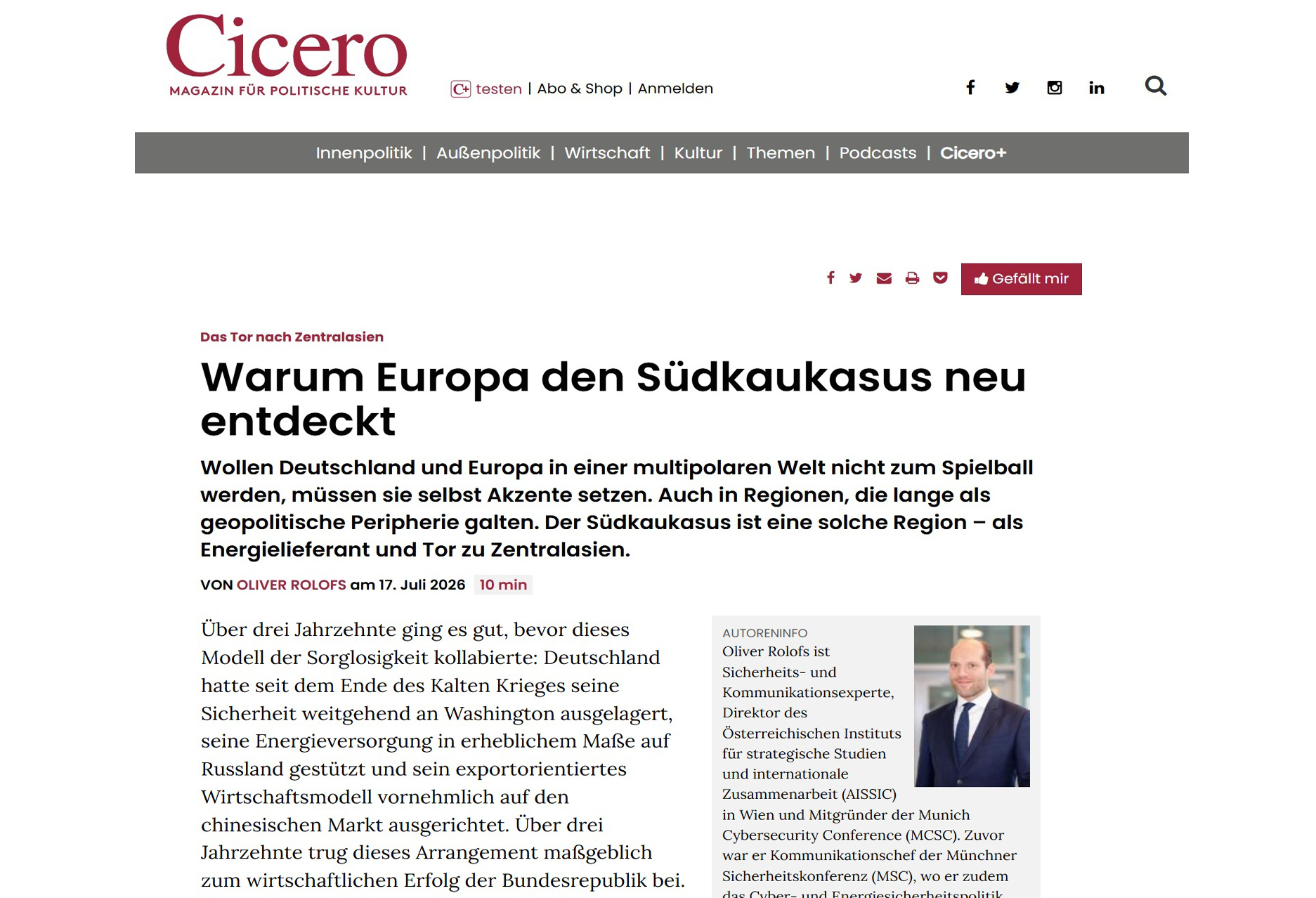
The influential German magazine Cicero published an article headlined "The gateway to Central Asia - Why Europe is rediscovering the South Caucasus?”
The article analyzes the profound transformation in Europe's relationship with the South Caucasus, driven by shifting geopolitical realities in recent years. Author Oliver Rolofs, a security and communications expert, notes that the pandemic, the Russia-Ukraine war, and rising Middle East tensions have dramatically reshaped Europe's security, energy, and transport policies.
“First the pandemic, and then Russia-Ukraine war shattered these assumptions and forced Germany and Europe into a role they had never intended to play: either becoming pawns in a multipolar world or emerging as geopolitical actors in their own right. This realization has one inevitable consequence: it changes the way Europe looks at the map. Regions that were long considered geopolitical peripheries are suddenly moving to the center of European interests,” the expert mentions.
“After the Cold War, open markets and global supply chains dominated international affairs. Straits, transit corridors, and pipelines were taken for granted as the infrastructure of global trade, while the geostrategic significance of these transport routes received relatively little attention. Russia-Ukraine war changed that overnight. Pipelines became instruments of political pressure, ports turned into strategic targets, and undersea cables emerged as critical infrastructure.
The current war involving Iran, together with the continuing tensions surrounding the Strait of Hormuz, has further intensified the debate over resilience, economic security, and strategic sovereignty. These developments illustrate a broader trend: geography has returned as a factor of power, especially at the critical chokepoints through which energy flows, data is transmitted, and goods and raw materials are transported. This is precisely why Europe is increasingly turning its attention to a region long viewed primarily as a source of conflict: the South Caucasus,” the article emphasizes.
“For decades, the region was viewed almost exclusively through the lens of the conflict between Armenia and Azerbaijan over Garabagh, a region internationally recognized as part of Azerbaijan. The war shaped political perceptions but obscured the region’s broader geostrategic potential. Since the peace initiative launched in Washington on August 8, 2025, between Armenia and Azerbaijan, that perception has begun to change in Brussels and other European capitals.
The road to a lasting peace remains long. Border demarcation, mine clearance, and confidence-building measures have yet to be fully resolved. Nevertheless, the strategic context has changed fundamentally. Europe is beginning to see the South Caucasus not merely as a conflict zone but as the bridge connecting Europe with Central Asia. Azerbaijan has already become an indispensable energy supplier for Europe,” the expert says.
“Since the Strategic Energy Memorandum between the European Union and Azerbaijan was signed in July 2022, Baku has steadily expanded its role as an alternative supplier of natural gas. The agreement aims to increase annual gas deliveries to at least 20 billion cubic meters by 2027. To date, Azerbaijan has already raised its exports to the European Union to 13 billion cubic meters per year, compared with just 8 billion before 2022.
Since January 2026, Germany and Austria have also begun receiving direct supplies for the first time. One cornerstone of this development is a ten-year contract between SOCAR and the German energy company SEFE for the annual delivery of 1.5 billion cubic meters of natural gas. Azerbaijan now supplies gas to sixteen countries, including ten EU member states. In a remarkably short period, the Caspian nation has become a key pillar of Europe’s diversification strategy,” Oliver Rolofs underlines.
The author says that through the Southern Gas Corridor, Europe now has an energy connection from the Caspian region that completely bypasses Russian territory. “This infrastructure project includes several pipelines, among them the Trans-Anatolian Pipeline (TANAP), which transports natural gas from the Shah Deniz field in the Caspian Sea near Baku through Georgia and Türkiye to Europe’s border. From there, the Trans Adriatic Pipeline (TAP) carries the gas onward to Greece, Albania, and Italy,” he further adds.
“TANAP and TAP have become central to Europe’s efforts to reduce its geopolitical dependencies. Yet Azerbaijan’s strategic value extends well beyond its role as an energy supplier. It also serves as the indispensable gateway to Kazakhstan—the strongest economy and richest resource base in Central Asia and another key European Union partner in the region. From the Kazakh ports of Aktau and Kuryk, the Middle Corridor crosses the Caspian Sea to Baku before continuing toward the Black Sea and Europe.
As a result, Azerbaijan has also become Europe’s access point to Central Asia and to the so-called Middle Corridor, formally known as the Trans-Caspian International Transport Route, whose importance has grown significantly. The corridor links Europe via Azerbaijan with Turkmenistan, Kazakhstan, Uzbekistan, China, and the wider Central Asian markets,” the expert says.
Oliver Rolofs emphasizes that the European Union now treats the corridor as a strategic infrastructure project under its Global Gateway strategy, noting that at the end of June 2026, Brussels and Astana reaffirmed their intention to accelerate the expansion of the Middle Corridor and deepen cooperation in energy, digitalization, and critical raw materials.
“In early July, what stood out in Baku was not so much the announced investment package as the language used by Ursula von der Leyen. The President of the European Commission described the South Caucasus as “one of the world’s greatest hubs,” linking Europe with the Caspian region and Central Asia. Few countries, she argued, are as well positioned as Azerbaijan to promote regional cooperation and stability, she said in Baku alongside Azerbaijani President Ilham Aliyev,” the author underscores.
“Von der Leyen also explicitly praised Azerbaijan as a “reliable and trustworthy energy partner.” She described the Southern Gas Corridor as a success story for European energy security and outlined the next phase of the partnership: expanding renewable energy, establishing a Green Energy Corridor between the Caspian Sea and Europe, and strengthening cooperation on electricity grids and regional energy infrastructure. Increasing Azerbaijan’s share of renewable energy production could also free up additional natural gas for export to Europe, further strengthening energy security,” the article mentions.
Highlighting that Germany, too, has increasingly recognized the geopolitical importance of the South Caucasus, the expert says: “Federal President Frank-Walter Steinmeier’s visit to Armenia and Azerbaijan in late March and early April 2025 was far more than a ceremonial diplomatic trip; it reflected Berlin’s growing interest in energy and infrastructure policy. For Germany, the issue is no longer simply about natural gas. It is about resilient supply chains, industrial competitiveness, and access to the markets of Central Asia. Against this backdrop, Chancellor Friedrich Merz has invited President Ilham Aliyev to pay an official visit to Germany, with the aim of further expanding political and economic relations with Azerbaijan within the framework of Europe’s energy, infrastructure, and connectivity strategy.”
Azerbaijan’s Milli Majlis, Inter-Parliamentary Speakers’ Conference explore cooperation
Azerbaijani FM meets with Ukrainian President
Jeyhun Bayramov informed Ukrainian President on post-conflict realities in the South Caucasus
FM Bayramov: We also would be happy to provide gas also to friendly Ukraine, in case of necessity