Baku hosts international conference on Belgium’s colonialism
Baku, August 21, AZERTAC
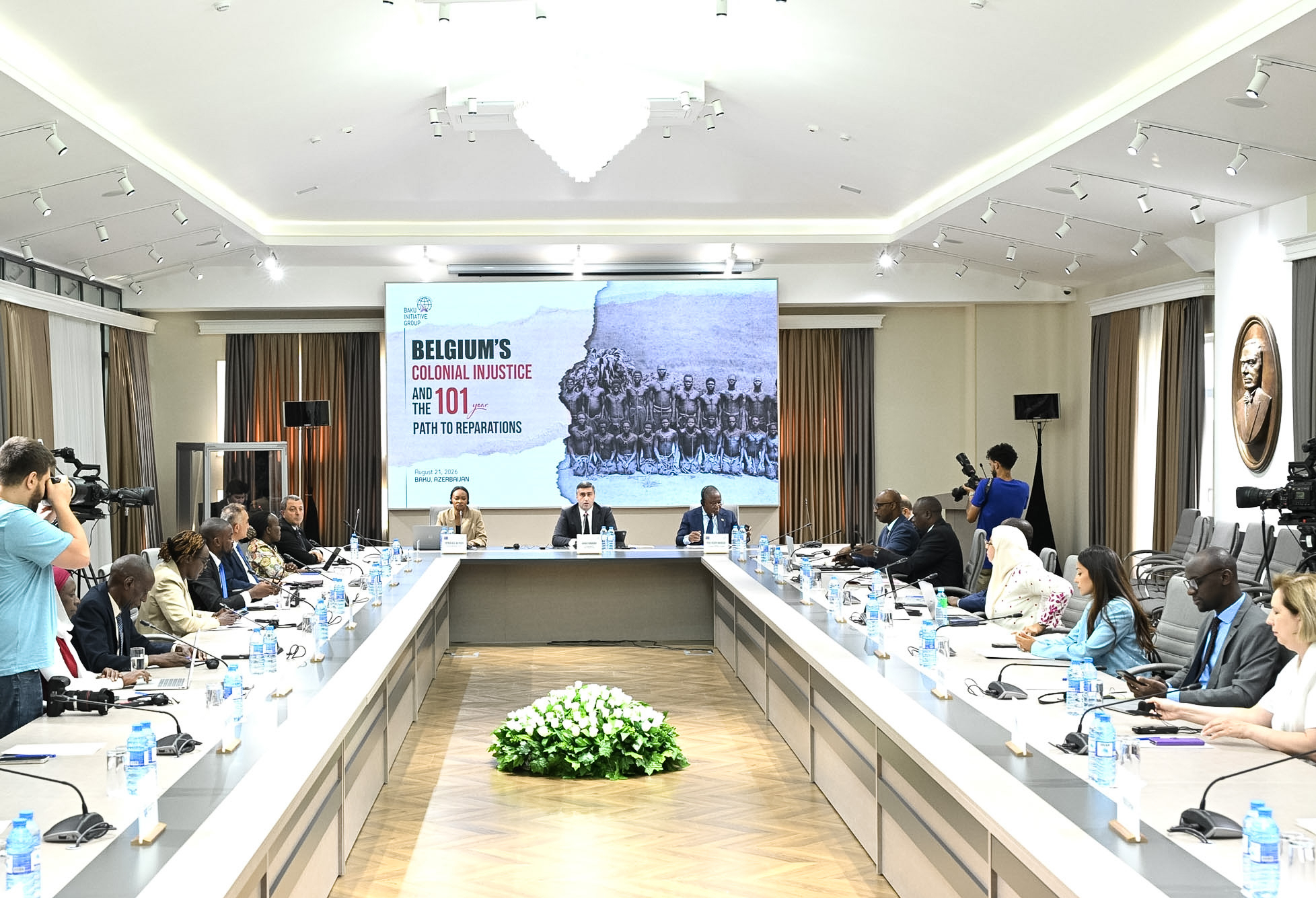
An international conference titled “Belgium’s Colonial Injustice and the 101-Year Path to Reparations” was held in Baku on August 21.
The event, organized by the Baku Initiative Group (BIG), was attended by representatives from the Democratic Republic of the Congo (DRC), Rwanda, Burundi, Morocco, and South Africa, as well as UN Human Rights Council experts, diplomats, parliamentarians, human rights advocates, historians, and international law experts.
The conference discussed the historical, political, economic, and social harm inflicted on the peoples of Central Africa by Belgium’s colonial policies, the ongoing impact of the colonial legacy, the restoration of historical justice, reparations, and the restitution of cultural heritage.
In his remarks, BIG Executive Director Abbas Abbasov stressed that addressing colonial crimes requires more than financial compensation, calling for recognition of historical responsibility, official apologies, reparations, and legal safeguards. He noted that the DRC, Rwanda, and Burundi have long awaited concrete action and stressed that reparations should be pursued transparently and in accordance with international law.
Paul Nsapu Mukulu, President of the DRC’s National Human Rights Commission and Ombudsman, noted that an objective examination of Belgium’s colonial history is essential to restoring historical justice, ensuring victims’ access to justice, and preventing similar abuses in the future.
DRC National Assembly member Francis Tshibalabala Mukunayi emphasized that addressing colonial policies requires recognition of historical truth. He highlighted the exploitation and abuses of the colonial period, while describing the DRC’s independence as a testament to resistance and dignity. He stressed that reparations should be viewed as a means of achieving justice, accountability, and reconciliation rather than as an act of revenge.
In his address, Charles Kayonga, Rwanda’s Ambassador to Türkiye, Azerbaijan, Kazakhstan, and Lebanon, residing in Ankara, underscored that colonialism left a lasting legacy that continues to affect former colonies, highlighting the need to address it in discussions on responsibility and reparations.
Esther Kile Wa Ngoy of the DRC National Commission for UNESCO said Belgian colonial rule caused exploitation, economic dependency, and social inequality, and called for a broader, more transparent process to return African cultural heritage to its countries of origin.
Participants highlighted the appropriation and restitution of colonial-period cultural heritage, noting that Belgium’s Royal Museum for Central Africa holds around 85,000 objects from Central Africa. The event also underscored the five forms of reparation set out in UN General Assembly Resolution 60/147: restitution, compensation, rehabilitation, satisfaction, and guarantees of non-repetition.
Participants called for greater international recognition of colonial-period injustices, stronger legal mechanisms, and more systematic discussion of reparations. They stressed that restoring historical justice is essential not only for addressing the past but also for building a fairer international system for future generations.
Kazakhstan, Azerbaijan discuss TITR development, non-resource exports expansion
Azerbaijani Ambassador presents credentials to Costa Rican President
Baku hosts international conference on Belgium’s colonialism
EANA celebrates 70 years of supporting news agencies across Europe
Congolese MP: We do not call for revenge, but for justice, truth and dignity