Bulgaria records EU’s largest increase in government R&D budget allocations per capita since 2015
Baku, August 7, AZERTAC
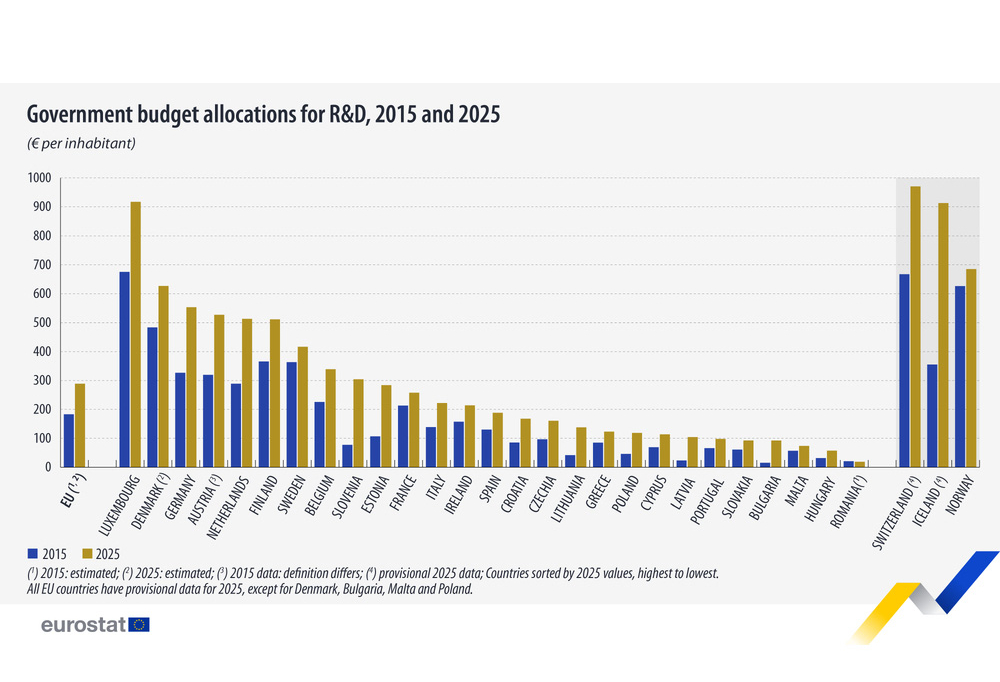
In Bulgaria, government budget allocations for research and development (R&D) increased almost sixfold, from EUR 15.5 per inhabitant in 2015 to EUR 92.3 in 2025, representing a 495.5% increase, the highest among EU countries, the Bulgarian News Agency (BTA) reported citing to Eurostat data.
In 2025, EU governments allocated an estimated EUR 130.2 billion in their budgets to research and development (R&D), equivalent to 0.69% of GDP. This represents a 2.4% increase from 2024, when the amount stood at EUR 127.144 billion, and a 60.5% increase compared with 2015, when it was EUR 81.138 billion.
In 2025, government budget allocations for R&D at EU level stood at EUR 288.9 per inhabitant, a 57.7% increase compared with 2015, when they amounted to EUR 183.2 per inhabitant.
Luxembourg, at EUR 917.2 per inhabitant, recorded the highest R&D budget allocations per person among EU countries, followed by Denmark at EUR 627.1 and Germany at EUR 553.5. The lowest levels were recorded in Romania, at EUR 18.8 per inhabitant, Hungary, at EUR 57.4, and Malta, at EUR 73.7.
Bulgaria recorded EUR 92.3 per inhabitant, placing it just above Malta.
Compared with 2015, Romania, down 9.6%, was the only EU country to register a decrease in its budget allocations for R&D in terms of euro per inhabitant, from EUR 20.8 in 2015 to EUR 18.8 in 2025.
The other EU countries registered increases ranging from 14.7% in Sweden, from EUR 363.4 per inhabitant in 2015 to EUR 416.7 in 2025, to 495.5% in Bulgaria, from EUR 15.5 to EUR 92.3.
In terms of distribution by socioeconomic objectives, 37.3% of government budget allocations for R&D (GBARD) was directed to the general advancement of knowledge, primarily financed by a public block grant known as public general university funds (GUF), used by public higher education institutions to support their activities.
Additionally, 18.4% of GBARD was dedicated to the general advancement of knowledge from sources other than GUF, 9.5% to industrial production and technology, 6.7% to health, and 5.8% to defence.
Türkiye says Greece's tourism framework carries no legal consequences for Ankara
Japan orders evacuations as Typhoon Dolphin approaches, cancels 500 flights
Spanish police dismantle major Mediterranean migrant and drugs smuggling network
FAO Food Price Index edges higher in July on stronger crop prices