Most-detailed-ever image of sun reveals roiling waves for first time
Baku, August 6, AZERTAC
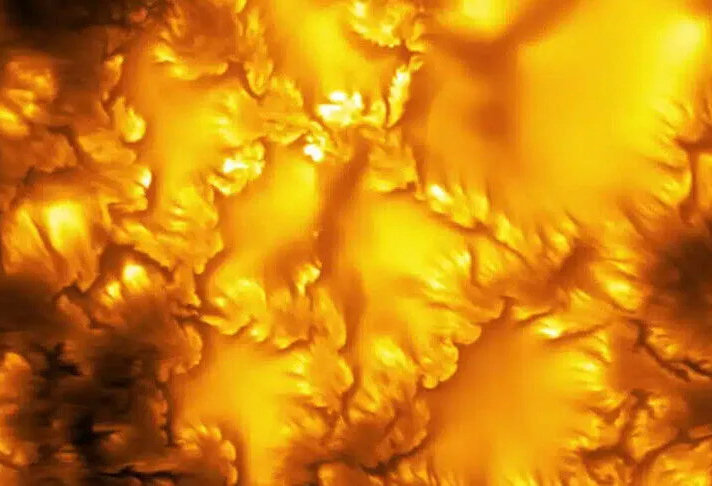
The clearest images ever taken of the sun’s surface reveal striking wave patterns, reminiscent of those sometimes seen in clouds on Earth, according to NewScientist. Analysis of the patterns may improve our predictions of solar weather.
On 14 April 2025, with just a few minutes of their allotted time remaining at the Daniel K. Inouye Solar Telescope in Hawaii and with clouds fast closing in that would force the closure of the observatory’s lens cover, a team of astronomers collected a series of extraordinary images – the most detailed ever recorded of the sun’s surface, known as the photosphere.
Most remarkably, the images revealed, for the first time, wave-shaped vortices known as Kelvin–Helmholtz instabilities (KHI) that had long been predicted to exist on the sun but had never before been observed.
“These swirling, vortex-like patterns are universal, appearing in cloud formations, ocean currents and across the cosmos,” says team member David Kuridze at the National Solar Observatory in Colorado.
“A famous example is [Vincent] van Gogh’s The Starry Night, where the sky’s vortex structures closely resemble turbulent KHI structures,” he says. “A similar parallel appears in Hokusai’s famous woodblock print, The Great Wave off Kanagawa, where the curling crests of the wave echo the iconic shape of KHI billows.”
Another member of the team, Friedrich Wöger, also at the National Solar Observatory, says that while the existence of some KHI in the solar photosphere was expected, it was a surprise to see the patterns “everywhere” in the images they processed.
The scale of what they were seeing was extraordinary – the telescope is 150 million kilometres from the sun, but it could pick out objects just a few tens of kilometres in length on its surface.
“Detecting and following the development of the 25 kilometre-size KHI vortices on the sun and identifying them as such is similar to identifying and tracking the motion of an average-sized ant on the ground from 160 km away,” says Wöger.
The KHI wave structures are formed on the boundaries of what the researchers describe as “granules”, structures between 500 and 2000 km in diameter, which are cells of rising plasma emerging from deep within the sun. The granules observed in the study were either close to a sunspot – a dark patch where magnetism blocks the escape of heat – or to one of numerous smaller sunspots called pores.
Munich car-ramming attacker sentenced to life in prison
UK clears Paramount’s stalled $110B Warner Bros. Discovery takeover
Lebanon, Israel begin final day of 7th round of negotiations in Rome
Butterflies are rapidly changing where they live as climate changes
Trump tells donors, ‘We need to elect JD,’ in 2028 presidential election: Report