May 30 marking World Day Against Trafficking in Persons
Baku, July 30, AZERTAC
The 30th of July marks the World Day Against Trafficking in Persons, according to the UN.
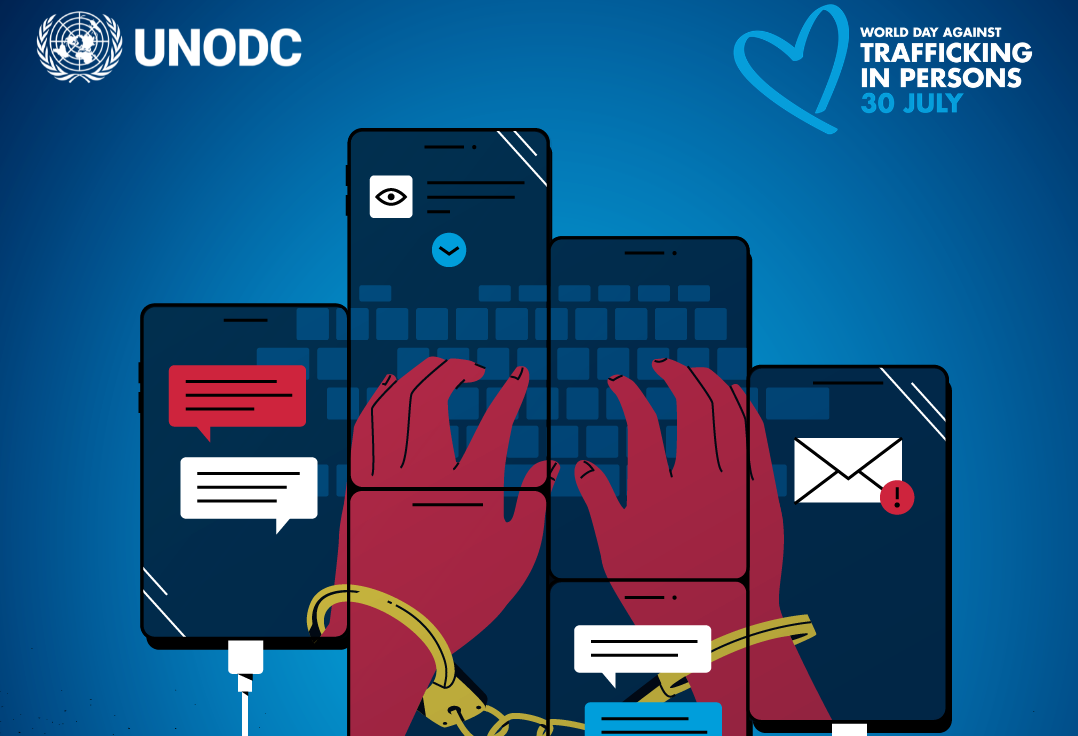
The 2026 World Day Against Trafficking in Persons theme, "Trapped Behind the Scam," draws attention to a rapidly expanding form of human trafficking in which transnational organized crime groups exploit people to carry out industrial-scale financial fraud. Victims are trafficked for forced criminality and compelled to participate in online scam operations. This form of exploitation is closely linked to cybercrime, financial fraud, money laundering, and corruption, demonstrating the increasingly interconnected nature of organized crime.
Traffickers often recruit victims through fake job advertisements that promise legitimate employment opportunities abroad. Believing they are accepting genuine work, victims travel to another country only to find themselves confined in illegal scam compounds.
Within these compounds, victims are forced to conduct cyber-enabled fraud, including romance scams, cryptocurrency fraud, and other online schemes targeting people around the world. They are kept under constant surveillance and subjected to violence, threats, debt bondage, and demanding work quotas, leaving them trapped in conditions of fear with little opportunity to escape.
In East and South-East Asia, UNODC estimates that scams caused between US$18 billion and US$37 billion in financial losses in 2023 alone. A high proportion of these losses is linked to scams carried out by organized crime groups based in the region.
The UN Office for Drugs and Crime (UNODC) is supporting countries across South-East Asia to improve victim identification, investigations and prosecutions related to trafficking for forced criminality, cyber-enabled fraud and money laundering. This includes advanced training, support for specialized taskforces and stronger cross-border cooperation.
UNODC also advises countries on legal reforms needed to prosecute the full range of crimes connected to transnational organized crime, including large-scale money laundering, cyber-enabled crime and corruption.
Because these crimes often span multiple countries, international cooperation is essential. The United Nations Convention against Cybercrime, adopted by the General Assembly in December 2024, provides a new global framework to strengthen cooperation against digital crime, online fraud and technology-enabled organized crime.
The Convention supports faster international cooperation and more consistent collection and sharing of electronic evidence, helping authorities investigate and dismantle criminal networks operating across borders.
On World Day against Trafficking in Persons 2026, UNODC calls for stronger action to protect victims and improve cross-border judicial and law enforcement cooperation. These efforts are essential to disrupting the organized crime groups behind trafficking-linked scam operations.
Trafficking in persons is a serious crime and a grave violation of human rights. Every year, thousands of men, women and children fall into the hands of traffickers, in their own countries and abroad. Almost every country in the world is affected by trafficking, whether as a country of origin, transit or destination for victims. UNODC, as guardian of the United Nations Convention against Transnational Organized Crime (UNTOC) and the Protocols thereto, assists States in their efforts to implement the Protocol to Prevent, Suppress and Punish Trafficking in Persons (Trafficking in Persons Protocol).
The Protocol to Prevent, Suppress and Punish Trafficking in Persons defines Trafficking in Persons as the recruitment, transportation, transfer, harbouring or receipt of persons, by means of the threat or use of force or other forms of coercion, of abduction, of fraud, of deception, of the abuse of power or of a position of vulnerability or of the giving or receiving of payments or benefits to achieve the consent of a person having control over another person, for the purpose of exploitation. Exploitation shall include, at a minimum, the exploitation of the prostitution of others or other forms of sexual exploitation, forced labour or services, slavery or practices similar to slavery, servitude or the removal of organs.
Munich car-ramming attacker sentenced to life in prison
UK clears Paramount’s stalled $110B Warner Bros. Discovery takeover
Lebanon, Israel begin final day of 7th round of negotiations in Rome
Butterflies are rapidly changing where they live as climate changes
Trump tells donors, ‘We need to elect JD,’ in 2028 presidential election: Report